Szerző:
Értékelés:
Kiadva: 19.01.2011.
Nyelv : Angol
Szint: Főiskola/egyetem
Irodalom:
Referenciák: Nincs használatban

  • Prezentációk 'Intergenerational Relations', 1.
  • Prezentációk 'Intergenerational Relations', 2.
  • Prezentációk 'Intergenerational Relations', 3.
  • Prezentációk 'Intergenerational Relations', 4.
  • Prezentációk 'Intergenerational Relations', 5.
  • Prezentációk 'Intergenerational Relations', 6.
  • Prezentációk 'Intergenerational Relations', 7.
  • Prezentációk 'Intergenerational Relations', 8.
  • Prezentációk 'Intergenerational Relations', 9.
  • Prezentációk 'Intergenerational Relations', 10.
  • Prezentációk 'Intergenerational Relations', 11.
  • Prezentációk 'Intergenerational Relations', 12.
  • Prezentációk 'Intergenerational Relations', 13.
  • Prezentációk 'Intergenerational Relations', 14.
  • Prezentációk 'Intergenerational Relations', 15.
  • Prezentációk 'Intergenerational Relations', 16.
  • Prezentációk 'Intergenerational Relations', 17.
  • Prezentációk 'Intergenerational Relations', 18.
  • Prezentációk 'Intergenerational Relations', 19.
  • Prezentációk 'Intergenerational Relations', 20.
  • Prezentációk 'Intergenerational Relations', 21.
  • Prezentációk 'Intergenerational Relations', 22.
  • Prezentációk 'Intergenerational Relations', 23.
KivonatZsugorodni

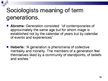
Sociologists meaning of term generations.
Abrams: Generation consisted “of contemporaries of approximately the same age but for whom mage is established not by the calendar of years but by calendar of events and experiences”

Heberle: “A generation is phenomena of collective mentality and morality. The members of a generation feel themselves liked by a community of standpoints, of beliefs and wishes.”

Achembaum argue, that generation is “both fuzzy and arbitrary”, because the very ambiguity of meaning makes it hard to know who is precisely included or excluded in such a definition.

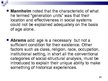
Mannheim noted that the characteristic of what he termed “generation units” was that their location and effectiveness in social systems could not be explained adequately on the basis of age alone.

Abrams add: age is a necessary but not a sufficient condition for their existence. Other factors such as class, religion, race, occupation, institutional setting, in short all the conventional categories of social-structural analysis, must be introduced to explain their unique ability to make something of historical experiences.

A szerző megjegyzéseBővíteni
Küldés e-mailben

Az Ön neve:

Adja meg az e-mail-címet, amelyen meg szeretné kapni a linket:

Üdv!
{Your name} szerint érdemes lehet megtekinteni ezt a dokumentumot az eKönyvtárban „Intergenerational Relations”.

A dokumentumra mutató link:
https://www.ekonyvtar.eu/w/889290

Küldés

E-mail elküldve