Értékelés:
Kiadva: 26.03.2021.
Nyelv : Angol
Szint: Főiskola/egyetem
Irodalom:
Referenciák: Nincs használatban
  • Összefoglalók, jegyzetek 'Allusions in Millay’s Sonnet “We Talk of Taxes, and I Call You Friend"', 1.
  • Összefoglalók, jegyzetek 'Allusions in Millay’s Sonnet “We Talk of Taxes, and I Call You Friend"', 2.
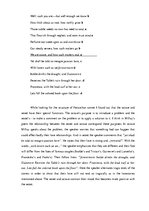
  • Összefoglalók, jegyzetek 'Allusions in Millay’s Sonnet “We Talk of Taxes, and I Call You Friend"', 3.
KivonatZsugorodni

While looking for the structure of Petrarchan sonnet I found out that the octave and sestet have their special functions. The octave’s purpose is to introduce a problem and the sestet’s - to make a comment on the problem or to apply a solution to it. I think in Millay’s poem the relationship between the sestet and octave correspond these purposes. In octave Millay speaks about the problem, the speaker worries that something bad can happen that could affect badly their love relationships. And in sestet the speaker comments that “yet shall be told no meagre passion here”. He states that their love is strong and „immortal”. With the words „with lovers such as we...” the speaker emphasizes that they are different and their fate will differ from the fates of famous couples (Isolde’s and Tristan’s, Guinevre’s and Lancelot’s, Franceska’s and Paolo’s). Then follow lines: “forevermore Isolde drinks the draught, and Guinevere Receives the Table’s ruin through her door, Francesca, with the loud surf at her ear, Lets fall the colored book upon the floor”. …

Küldés e-mailben

Az Ön neve:

Adja meg az e-mail-címet, amelyen meg szeretné kapni a linket:

Üdv!
{Your name} szerint érdemes lehet megtekinteni ezt a dokumentumot az eKönyvtárban „Allusions in Millay’s Sonnet “We Talk of Taxes, and I Call You Friend"”.

A dokumentumra mutató link:
https://www.ekonyvtar.eu/w/851748

Küldés

E-mail elküldve