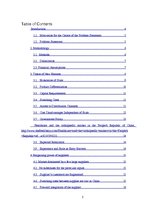
| Szám |
Fejezet |
Oldal. |
| |
Introduction |
4 |
| 1.1. |
Motivation for the Choice of the Problem Statement |
5 |
| 1.2. |
Problem Statement |
5 |
| 2. |
Methodology |
6 |
| 2.1. |
Methods |
6 |
| 2.2. |
Delimitation |
7 |
| 2.3. |
Financial Assumptions |
7 |
| 3. |
Threat of New Entrants |
8 |
| 3.1. |
Economies of Scale |
10 |
| 3.2. |
Product Differentiation |
11 |
| 3.3. |
Capital Requirements |
12 |
| 3.4. |
Switching Costs |
12 |
| 3.5. |
Access to Distribution Channels |
13 |
| 3.6. |
Cost Disadvantages Independent of Scale |
13 |
| 3.7. |
Government Policy |
15 |
| 3.8. |
Expected Retaliation |
15 |
| 3.9. |
Experience and Scale as Entry Barriers |
16 |
| 4. |
Bargaining power of suppliers |
16 |
| 4.1. |
Market dominated by a few large suppliers |
16 |
| 4.2. |
No substitutes for the particular inputs |
17 |
| 4.3. |
Supplier’s customers are fragmented |
17 |
| 4.4. |
Switching costs between supplier are low in China |
17 |
| 4.5. |
Forward integration of the supplier |
17 |
| 4.5.1. |
The buying industry is more profitable |
18 |
| 4.5.2. |
Economies of scale for the supplier |
18 |
| 4.5.3. |
The buying industry hinders the supplier’s development |
18 |
| 4.5.4. |
The buying industry has low entry barriers |
18 |
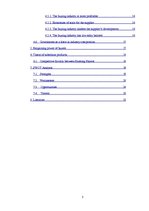
| 4.6. |
Government as a force in industry competition |
18 |
| 5. |
Bargaining power of buyers |
18 |
| 6. |
Threat of substitute products |
19 |
| 6.1. |
Competitive Rivalry between Existing Players |
20 |
| 7. |
SWOT Analysis |
20 |
| 7.1. |
Strengths |
21 |
| 7.2. |
Weaknesses |
21 |
| 7.3. |
Opportunities |
22 |
| 7.4. |
Threats |
22 |
| 8. |
Literature |
24 |