| Szám |
Fejezet |
Oldal. |
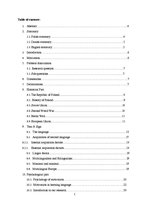
| 1. |
Abstract |
4 |
| 2. |
Summary |
4 |
| 2.1. |
Polish summary |
4 |
| 2.2. |
Danish summary |
5 |
| 2.3. |
English summary |
5 |
| 3. |
Introduction |
6 |
| 4. |
Motivation |
6 |
| 5. |
Problem formulation |
7 |
| 5.1. |
Research question |
7 |
| 5.2. |
Sub-questions |
7 |
| 6. |
Dimensions |
7 |
| 7. |
Delimitations |
7 |
| 8. |
Historical Part |
8 |
| 8.1. |
The Republic of Poland |
8 |
| 8.2. |
History of Poland |
9 |
| 8.3. |
Soviet Union |
10 |
| 8.4. |
Second World War |
10 |
| 8.5. |
Berlin Wall |
11 |
| 8.6. |
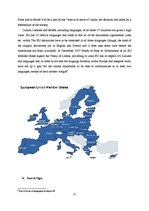
European Union |
11 |
| 9. |
Text & Sign |
13 |
| 9.1. |
The language |
13 |
| 9.2. |
Acquisition of second language |
17 |
| 9.2.1. |
Internal acquisition factors |
18 |
| 9.2.2. |
External acquisition factors |
18 |
| 9.3. |
Lingua franca |
19 |
| 9.4. |
Multilingualism and Bilingualism |
19 |
| 9.5. |
Maximal and minimal |
19 |
| 9.6. |
Multilingual Europe |
19 |
| 10.1. |
Psychology of motivation |
20 |
| 10.2. |
Btion in learning language |
22 |
| 10.3. |
Introduction to our research |
30 |
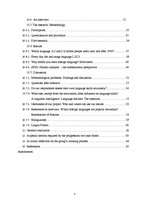
| 10.4. |
An interview |
31 |
| 10.5. |
The research. Methodology |
35 |
| 10.5.1. |
Participants |
35 |
| 10.5.2. |
Questionnaire and procedure |
35 |
| 10.5.3. |
Pilot research |
36 |
| 10.6. |
Results |
37 |
| 10.6.1. |
Which language (L2 and L3) do/did people learn until and after 1989? |
37 |
| 10.6.2. |
Every day life and usage language L2/L3 |
39 |
| 10.6.3. |
Why did/do you learn foreign language? Motivators |
40 |
| 10.6.4. |
SPSS. Statistic analysis – the mathematical perspective |
46 |
| 10.7. |
Discussion |
52 |
| 10.7.1. |
Methodological problems. Findings and discussion |
52 |
| 10.7.2. |
Questions after research |
53 |
| 10.7.3. |
Do our respondents assess their own language skills accurately? |
54 |
| 10.7.4. |
What else, except from the motivation, does influence on language skills? |
55 |
| |
A linguistic intelligence. Language abilities. The attention |
55 |
| 10.7.5. |
Usefulness of our project. Who and where can use our results |
56 |
| 10.7.6. |
References to interview. Which foreign languages are popular nowadays? Renaissance of Russian |
58 |
| 10.7.7. |
Bilingualism |
59 |
| 10.7.8. |
Lingua Franca |
60 |
| 11. |
General conclusion |
62 |
| 12. |
A special section required by the progression two year frame |
63 |
| 13. |
A critical reflection on the group’s working process |
64 |
| 14. |
References |
65 |
| |
Attachments |
65 |