Értékelés:
Kiadva: 31.07.2021.
Nyelv : Angol
Szint: Főiskola/egyetem
Irodalom: 4 egység
Referenciák: Nincs használatban

  • Prezentációk 'Bipolar Disease', 1.
  • Prezentációk 'Bipolar Disease', 2.
  • Prezentációk 'Bipolar Disease', 3.
  • Prezentációk 'Bipolar Disease', 4.
  • Prezentációk 'Bipolar Disease', 5.
  • Prezentációk 'Bipolar Disease', 6.
  • Prezentációk 'Bipolar Disease', 7.
  • Prezentációk 'Bipolar Disease', 8.
  • Prezentációk 'Bipolar Disease', 9.
  • Prezentációk 'Bipolar Disease', 10.
  • Prezentációk 'Bipolar Disease', 11.
  • Prezentációk 'Bipolar Disease', 12.
  • Prezentációk 'Bipolar Disease', 13.
  • Prezentációk 'Bipolar Disease', 14.
KivonatZsugorodni

Causes of bipolar disease
Multifactorial disease.
No certainty about the etiology.
It can be inherited, thus genes play an important role.
Mood swings can be brought on by either abnormal fluctuation of brain chemicals and stressful experiences or physical illness.

Bipolar in daily life
Affects males and females equally.
Onset of symptoms between the age of 15 and 30.
Higher risk if a family member is diagnosed.
Bipolar disrupts your goals at home and at work.
60% of people with bipolar disorder have trouble with drugs or alcohol.
People with bipolar disorder are 10 to 20 times more likely to commit suicide than people without the illness.

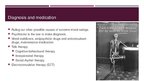
Diagnosis and medication
Ruling out other possible causes of extreme mood swings.
Psychiatrist is the one to make diagnosis.
Mood stabilizers, antipsychotic drugs and anticonvulsant drugs, maintenance medication.
Talk therapy
Cognitive behavioural therapy
Interpersonal therapy
Social rhythm therapy
Electroconvulsive therapy (ECT)


A szerző megjegyzéseBővíteni
Küldés e-mailben

Az Ön neve:

Adja meg az e-mail-címet, amelyen meg szeretné kapni a linket:

Üdv!
{Your name} szerint érdemes lehet megtekinteni ezt a dokumentumot az eKönyvtárban „Bipolar Disease”.

A dokumentumra mutató link:
https://www.ekonyvtar.eu/w/200897

Küldés

E-mail elküldve